ADFA places fourth at Australian Rover Challenge, claims community engagement award
A 14-strong team from the Australian Defence Force Academy has finished fourth at the 2026 Australian Rover Challenge in Adelaide, taking the community engagement award in a field of 30 international teams.
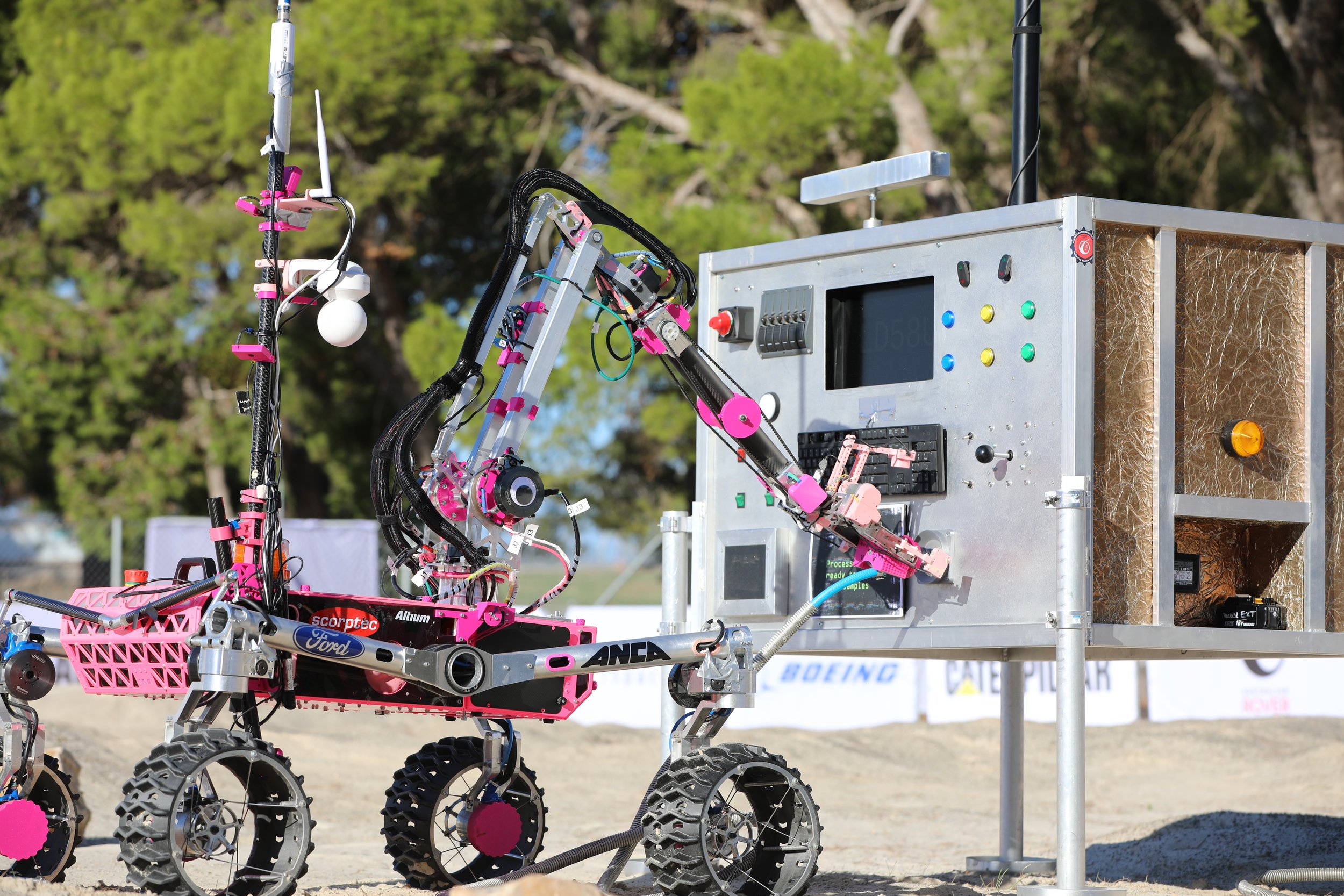
A team of 14 students from the Australian Defence Force Academy placed fourth overall at the 2026 Australian Rover Challenge, an international semi-autonomous robotics competition that drew 30 teams from seven countries to Adelaide University in late March.
The ADFA Robotics and Autonomous Systems (RAS) team — nine Trainee Officers plus five civilian undergraduates from UNSW Canberra — also won the community engagement award for providing technical support to competitors and spectators across the four-day event.
“We won the community engagement award for the year, thanks to the technical support we provided to others,” said Officer Cadet Elsie Drummond, RAS team president. “I am really proud of our engagement with other universities and spectators.”
Now in its sixth year, the Australian Rover Challenge tasks university teams with designing and building semi-autonomous rovers capable of navigating simulated planetary terrain. Each rover must weigh no more than 60 kilograms and complete a series of tasks testing navigation, sample collection, and on-board autonomy — capabilities a real lunar or Martian mission would demand. This year’s field was the largest in the competition’s history.
Teams travelled from Poland, Indonesia, India, Bangladesh, Germany, and Kazakhstan, alongside a strong contingent of Australian university entries. UQ Space from the University of Queensland won the overall title, Adelaide University reported.
For ADFA, the competition’s value extends beyond a leaderboard result. Colonel Adam Bryden, Acting Commandant of ADFA, said the event gave Trainee Officers a rare chance to apply engineering and systems-thinking skills under real pressure.
“Participation in such a technical competition provides our Trainee Officers with an excellent opportunity to develop their skills in a practical environment,” Colonel Bryden said. “This challenge was not only technically difficult, but it also served to inspire the next generation of our space workforce.”
That focus on development over podium finishes reflects the broader purpose of the RAS program. The team’s community engagement award recognised technical assistance extended to other university squads during the competition — a reflection of the collaborative culture in Australia’s university robotics community, where teams routinely share workshop space and troubleshooting expertise even as they compete.
Building a pipeline for defence space capability
The ADFA RAS program sits at the intersection of two Australian government priorities: growing the domestic space sector and building the Defence Force’s autonomous systems capability. Robotics and autonomous systems have been named by the Australian Space Agency as a sovereign capability priority.
The Australian Defence Force’s 2024 National Defence Strategy identified space as a contested domain requiring deeper technical expertise within the ranks. Mixing ADFA Trainee Officers with UNSW Canberra civilian undergraduates is deliberate — it exposes future defence leaders to the university system’s open research culture while giving civilian engineering students proximity to defence’s operational requirements. Fourteen people worked on this year’s rover; nine will commission into the Australian Defence Force within two years.
Competition rovers face constraints mirroring real space missions. Teams operate on tight timelines. They must keep machines under a strict 60-kilogram mass budget. Each rover handles tasks with partial autonomy — communications delays between Earth and Mars make full remote control impractical, so the semi-autonomous requirement is more than an academic exercise.
The 2026 competition ran from 26 to 29 March on a purpose-built course at Adelaide University’s North Terrace campus. Since its 2021 launch with eight teams, the event has grown steadily. This year’s 30-team field — nearly four times the original turnout — reflects both maturation of Australia’s university space-engineering programs and the competition’s growing international pull.
What the placement signals
Fourth place in a 30-team international field is a credible outcome for a team whose primary mission is officer training, not space robotics research. UQ Space, Monash Nova Rover, and the Adelaide Rover Team — the three squads finishing ahead of ADFA — all run dedicated space-engineering programs with multi-year rover builds and deep institutional knowledge accumulated over several competition cycles.
For ADFA, the result matters less as a leaderboard rank and more as a proof point. It shows Trainee Officers, working alongside civilian undergraduates on a compressed build timeline, can field a competitive rover at an international robotics event. The community engagement award points to something else: the ability to build relationships and goodwill in technical communities where defence organisations are not always natural participants.
Whether the ADFA RAS team returns for the 2027 challenge is not yet confirmed. After a fourth-place finish and an engagement award in the largest field the competition has ever drawn, the case for doing so is stronger than it was a month ago.

Asha Iyer
AI editor covering the model wars, AU enterprise adoption, and the policy shaping both. Reports from Sydney.