Project Solara reveals Microsoft’s agent-device bet
Project Solara points to Microsoft’s bigger AI plan: enterprise agents running on managed devices, not only inside Windows.
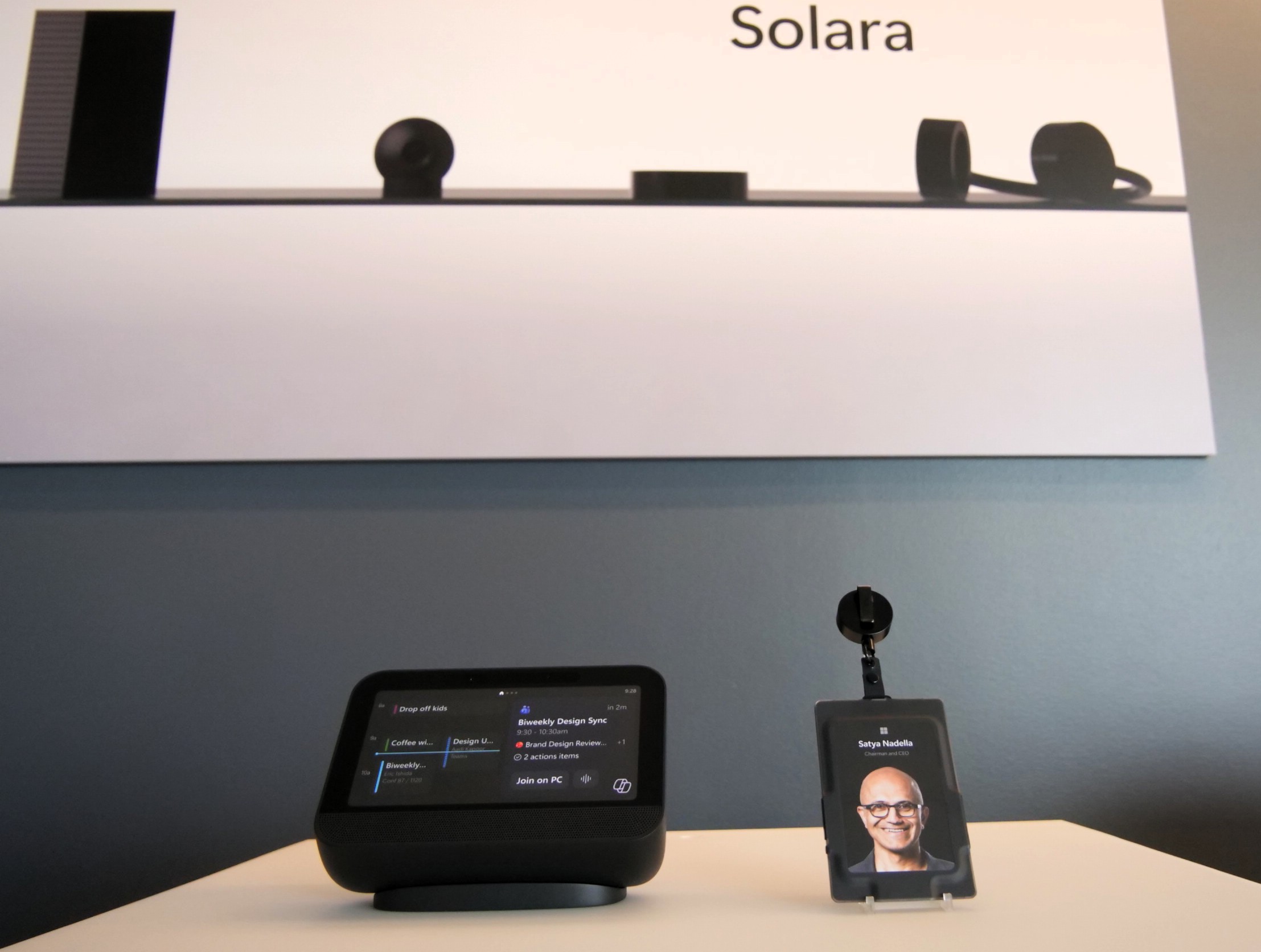
Project Solara is the sharper Build-era signal than another Copilot feature drop. Microsoft is testing a platform for devices designed around AI agents, with Android underneath and business pilots already under way. The company showed a desk hub and a wearable badge, and GeekWire reported that AccuWeather, Best Buy, CVS Health, Levi’s and Target are among the pilot customers.
The badge is the visible hook. The larger signal is Microsoft’s willingness to treat Windows as optional when the job is cheap, always-nearby, agent-first hardware for workplaces that do not need a full PC.
For enterprise buyers, the read gets less tidy. ZDNet Australia’s analysis of Work IQ frames the obvious concern: smarter agents may reduce workflow friction, but they can also add licensing, monitoring, data exposure and cost-control problems. Solara only makes sense if Microsoft can turn that control plane into trust rather than another dashboard.
The shift is from app launcher to workplace presence
The company’s own language makes clear that Solara is not being pitched as a new shell for old software. In its Project Solara essay, Microsoft described a chip-to-cloud platform for agent-first experiences and said the devices are meant to compose hardware, model access and management tools as one stack.
“Not devices built around apps, but devices built around agents.”
Source: Microsoft, Command Line
That phrasing moves the centre of gravity away from the app menu. In a conventional workplace device, the user chooses a programme, opens a file, asks a question, waits for a response, then switches tools. Under the Solara framing, the device sits in the room, on the desk or on the worker, and the agent is the interface.
Stevie Bathiche, Microsoft CVP and technical fellow in the Applied Sciences Group, put the point more plainly in the GeekWire briefing.
“This is a way to put computing in those spaces easily and cheaply, but more importantly, it’s a way to put your agent into those spaces.”
Source: Stevie Bathiche, Microsoft Applied Sciences Group
The examples remain early. A desk hub could follow a meeting, surface files and hand work back to Microsoft 365. A badge could give frontline workers a context-aware interface when a laptop is impractical. None of that proves demand. It does show the company trying to make the agent physically present in work environments where the PC is not the natural unit.
Android matters because Windows is too heavy for this job
Solara’s striking technical choice is Microsoft Device Ecosystem Platform, an Android-based system, rather than Windows. That is not a small concession from a company whose power in enterprise IT has long come from making Windows the default endpoint for work.
GeekWire’s reporting says Microsoft chose the Android-based MDEP for smaller, lower-power form factors. Microsoft’s own post talks about reference designs, off-the-shelf silicon and a chip-to-cloud approach. Read together, the message is direct: if an agent device needs to be cheap enough to deploy widely and flexible enough to fit a store floor, clinic or service desk, the traditional PC stack may be the wrong starting point.
Windows is not retreating from the enterprise in this version of the story. Microsoft is separating the device substrate from the management layer. Entra, Intune, Defender and Purview still do the enterprise work. Hardware can be lighter because the control plane is where customers are meant to feel locked in.
That also separates Solara from the consumer AI gadget cycle. Humane’s AI Pin and Rabbit’s R1 became shorthand for the problem of shipping a new object before the use case is durable. Microsoft is instead aiming at employers that already run identity, compliance and collaboration through its cloud. A badge that recognises an employee, checks permissions and routes a task through Microsoft 365 is a different proposition from a gadget asking consumers to replace their phone.
The moat is Work IQ, not the badge
A badge and desk hub are easy to photograph. Work IQ is the more consequential part. Microsoft said its Work IQ APIs will become generally available on 16 June, giving developers access to workplace context across people, emails, documents, meetings and other organisational systems.

“Work IQ is the workplace intelligence layer for agents, capturing how work actually happens across Microsoft 365, organizational systems and external sources: people, emails, documents, meetings and how they connect.”
Source: Microsoft, official Build 2026 blog
Context is the source of Microsoft’s advantage and the source of the risk. Agentic software needs workplace knowledge. Without it, the agent guesses, hallucinates or asks the user to restate what the company already knows. With it, the agent can become useful, but only by sitting close to sensitive data.
Charles Lamanna’s Copilot and agents organisation is trying to turn that proximity into a product category. Satya Nadella has spent the past two years pushing Microsoft from software suite to AI platform. Solara extends that argument into hardware: the agent is not just a side panel in Word or Teams, it is an authorised workplace actor that can move between endpoints.
Australian CIOs may find that attractive and uncomfortable at the same time. Microsoft can argue that agent devices inherit familiar governance. Security teams can ask whether microphones, cameras and ambient interfaces make consent, audit trails and deletion rights harder to explain to staff and customers. Both claims can be true.
The competition is chasing bodies for agents
Solara lands as the wider AI hardware race becomes more serious. Meta is expanding smart glasses and has reportedly explored an AI pendant, according to TechCrunch reporting. OpenAI’s Jony Ive-led device remains deliberately vague, with Business Insider reporting that even OpenAI’s chief financial officer would not say whether it is an earpiece. Google has been pushing Gemini into glasses and other ambient interfaces.
Microsoft’s path is less glamorous. That may be the point. Rather than ask whether consumers want another personal device, it can ask whether a retailer, hospital, logistics operator or call centre wants a managed endpoint that brings an agent closer to the work.
The Verge described Project Solara as an operating system for AI agent gadgets, but Microsoft’s enterprise pitch is narrower than that label suggests. It is not trying to win the gadget shelf first. If agents leave the PC, Microsoft wants to own the identity, context and governance that make them deployable at scale.
The hard questions are operational
Buyers should start with the task, not the device. What becomes measurably easier on a badge or desk hub than on a phone, Teams client or Windows PC? If the answer is only “talk to Copilot in another place”, the platform will struggle.
Cost comes next. Work IQ could lower latency and token usage by giving agents better context, but it could also create a new consumption layer whose spending is difficult to predict. Enterprises that have already faced cloud optimisation and AI coding-tool backlash will recognise the pattern: pilots look efficient until every workflow has an agent attached.
Disclosure may be harder. Always-nearby devices can record, transcribe or infer in spaces where bystanders did not choose to use AI. In Australia, that will sit beside workplace surveillance rules, privacy reform and sector-specific obligations. Microsoft can offer controls, but employers will still have to explain when the agent is listening, what it stores and who can review the record.
Solara therefore looks less like a product launch than a probe. Microsoft is testing whether enterprise AI needs a new device layer, and whether customers will accept Android-based hardware as long as the Microsoft control plane remains intact.
If that works, the next computing layer may not arrive as a new version of Windows. It may arrive as a managed agent that follows work across rooms, counters and badges, with Microsoft sitting quietly underneath the permissions.

Soren Chau
Enterprise editor covering AWS, Azure, and GCP in the AU region, plus the SaaS shaping local IT. Reports from Sydney.