AI in schools: Australia lags Asia on classroom rules
AI in schools is moving from ban debate to classroom playbooks in Asia, while Australia still leans on broad guardrails and trust warnings.
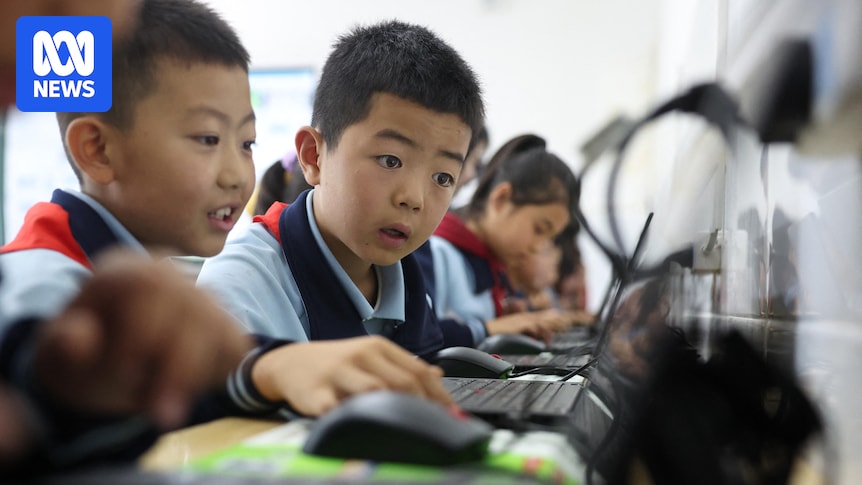
Countries across Asia are moving faster than Australia to define what artificial intelligence belongs in a classroom, not just whether students should be allowed to use it. China, Singapore, Japan and South Korea are shifting from AI panic to timetabled instruction and teacher-facing programmes, according to ABC News reporting on Asian school systems. Australia has a national framework, but the live debate still leans toward integrity, screen exposure and public distrust. That gap matters because students are already using the tools, while teachers are still waiting for usable guidance.

The question for Australia is no longer whether generative AI should enter schools. It has. The policy question is whether schools get a teaching model before the tools become another private workaround, used by confident students and banned only on paper.
Asia is turning AI into curriculum
The clearest difference is administrative. Beijing is requiring eight hours of AI education a year. Guangdong has set six hours a year for lower grades and one hour a fortnight for students in years 10 and 11. Singapore, which has taken a more cautious public line, is still building AI into the system through school pilots and teacher materials.
Desmond Lee, Singapore’s education minister, has framed the problem as one of sequencing. Students need to understand the subject before they use AI to accelerate it. That is close to the caution Australian educators often express, but Singapore is pairing the caution with deployment.
Neil Selwyn, a Monash University professor who researches AI in schools, gave the ABC the cleanest version of the Australian sceptic’s case:
“AI last rather than AI first.”
— Neil Selwyn, Monash University, quoted by ABC News
Selwyn’s warning should not be dismissed as resistance. He also told the ABC that some rollouts had been too broad and too fast:
“It was just rolled out far too quickly, and it was quite extensive.”
— Neil Selwyn, Monash University, quoted by ABC News
That is the useful tension. Australia does not need to copy the fastest regional systems. It does need to move from a framework that says AI use should be safe, fair and transparent to classroom examples that tell a year 8 science teacher, a year 10 English teacher and a deputy principal what to do on Monday morning.
Australia’s framework is necessary, but not enough
The Australian Framework for Generative Artificial Intelligence in Schools gives ministers and school systems a defensible starting point. It emphasises human wellbeing, transparency, fairness, privacy, accountability and teacher professionalism. Those principles are not trivial in a country where parents, unions and regulators are alert to deepfakes, assessment fraud and data collection.
The weakness is that principles age slowly while products move weekly. A school can agree with every line of the framework and still have no shared answer on when a student may use a chatbot to generate practice questions, whether a teacher may use AI to draft feedback, or how to assess work when students have used an assistant as a tutor.

That is where Asian systems are applying pressure. The regional lead is not simply about national pride. It is about procurement, teacher training, assessment design and the software habits students carry into university and work.
Australia’s trust problem makes the job harder. An ABC analysis of Australian attitudes to AI cited polling showing only 4 per cent of Australians trusted AI companies with their private information. In schools, that figure is a policy constraint. Families are unlikely to accept classroom AI if it is sold as efficiency software for vendors. They may accept it if it is explained as literacy, feedback and supervision under public rules.
The bottleneck is teacher guidance
The strongest argument for moving faster is not that AI is good. It is that unmanaged AI is already here.
Amy Loyd, chief executive of All4Ed, put the point plainly in Axios reporting on teacher guidance:
“AI is out there. It’s not a question of whether or not our students are going to be using it.”
— Amy Loyd, All4Ed, quoted by Axios
US polling collected by Axios and NPR points to the same operational gap that Australian systems risk reproducing. NPR reported that about 80 per cent of teachers said they had received no formal guidance on applying AI at work. Seventy-one per cent said they had no guidance on using AI for coaching and feedback; 69 per cent said the same for one-on-one tutoring.
Those numbers matter because teacher discretion is where policy becomes practice. If guidance is absent, schools default to three uneven models: quiet student use, local bans that are hard to enforce, or enthusiastic adoption by teachers who have the time and confidence to experiment. None is a system.
This is also where the screen-time backlash can blur the issue. Axios has reported that some classrooms are leaning back into analogue learning in response to AI and broader technology fatigue. That is understandable. It is not a substitute for AI literacy. A school can reduce device distraction and still teach students how to interrogate a model’s answer, protect personal information and decide when not to use a tool.
Competitiveness is entering the classroom
The education argument is becoming a labour-market argument. Code.org’s shift into CodeAI was built around a stark gap: GeekWire reported that 84 per cent of high school students were already using AI, while only 16 per cent of high school leaders said all students were learning about it in school.
Australia is seeing the same pressure at the tertiary and skills end. La Trobe has been promoting an AI-first university strategy, Build Club has launched a free virtual AI school, and employers are increasingly treating prompt use, verification and workflow design as basic digital capability. Schools cannot solve that whole transition. They do shape the baseline.
The risk for Australia is not that every Asian classroom becomes a flawless AI laboratory while local schools stand still. The more plausible risk is slower and less visible: neighbouring systems normalise guided AI use, teachers build shared practice, students learn the limits early, and Australian schools keep treating the issue as an assessment-integrity exception.
A workable Australian playbook would not start with a national chatbot licence. It would start with curriculum-linked examples, teacher training time, privacy-approved tools, clear boundaries for assessment, and student-facing lessons on verification. It would also say where AI does not belong. That last point is important. Selwyn’s “AI last” warning is stronger when it sits inside a deployment plan, not outside it.
Australia has been right to worry about trust, safety and cheating. The problem is that worry is not a classroom strategy. Asia’s faster-moving systems are showing that the next phase of AI policy is less about permission and more about practice. If Australia wants students to use AI carefully, it will have to teach the careful part before the workaround becomes the curriculum.

Marnie Blackwood
Regulation reporter on Privacy Act reform, eSafety, ACCC tech enforcement, and ACMA. Reports from Canberra.