Sydney Innovation Atlas maps where the city's startup clusters are forming
Committee for Sydney's new Innovation Atlas turns Greater Sydney's startup sprawl into a clearer map of clusters, funding gravity and policy gaps.
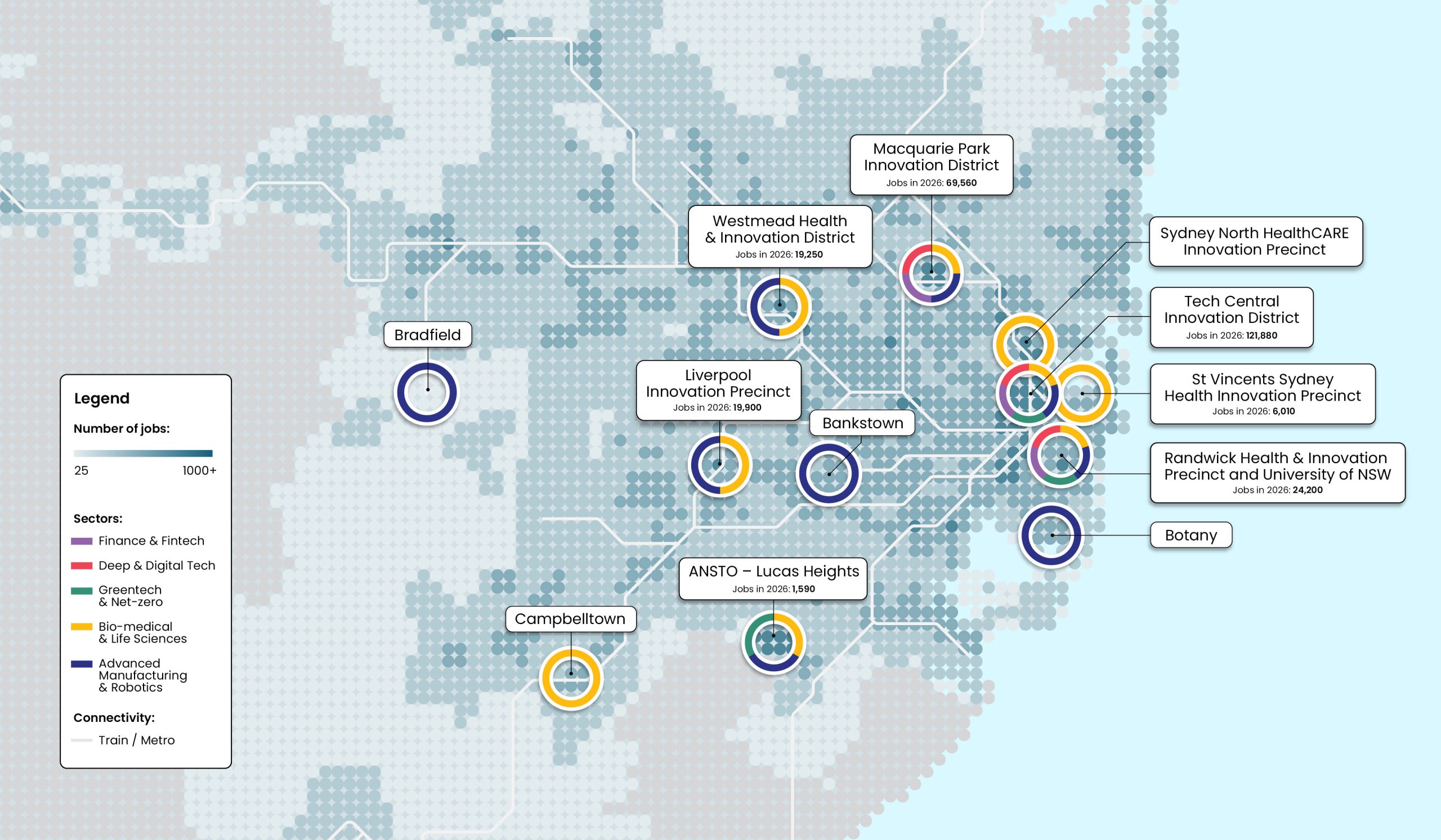
A new Committee for Sydney’s Sydney Innovation Atlas makes the case that Greater Sydney’s innovation economy has outgrown the single-CBD story. The atlas maps a set of linked districts — Tech Central, Macquarie Park, the Randwick health precinct, western Sydney campuses — each playing a different role in turning research muscle, talent and transport into startups. What the report hands the city’s tech sector is something it has rarely had: a common map. For founders, investors and policymakers, that beats another slogan about being Australia’s innovation capital.
The timing works. The atlas drops as the state government tries to convert precinct spending and planning reform into something measurable — commercial outcomes, not just ribbon-cutting — through the NSW Innovation Blueprint. The state has pointed to $38.5 million in budget funding for Tech Central, per the blueprint materials. That puts precinct policy under pressure to show returns in founder formation, research commercialisation and private capital, rather than construction activity alone. Sydney has mass. What it hasn’t had is an agreed story about how ideas move from campuses and hospitals into products, customers and follow-on funding. The atlas is closer to an operating diagram than a branding document — it’s a guide to where the next founder, lab partner or first enterprise customer is most likely to be found. It also gives a sharper answer to the long-running Sydney-versus-Melbourne argument, which usually gets fought in abstractions instead of infrastructure.
Density helps. Clarity about role helps more.
Tech Central is the obvious starting point. SMBtech’s launch coverage pegged the district at 121,880 jobs in 2026 — a number that would dwarf many standalone Australian tech hubs. Those aren’t all startup jobs, and the atlas would overshoot if it claimed they were. The stronger case is adjacency: universities, large employers, transport nodes and investors sharing a geography that shrinks the distance between research, hiring and first customers. A tight precinct means less friction for early-stage founders — more shots at serendipity, more reasons for talent to stay, more chances for a product team to sell into institutions already on the same map.
Outside Tech Central, the atlas reads less like a pyramid and more like a portfolio. Macquarie Park, at 69,560 jobs in the same coverage, isn’t treated as a satellite. It’s a second heavyweight. Randwick Health and Innovation Precinct and UNSW contribute another 24,200 jobs, giving Sydney a health-and-research cluster that looks different from the software-and-corporate mix around Central. Mature tech hubs aren’t usually monocultures. One node might be stronger at enterprise software, another at medtech or deep tech, a third at spinning university work into companies. NSW innovation minister Anoulack Chanthivong told SMBtech that companies can find their place in Sydney “whether it’s deep tech, health sciences or net-zero”. That’s the atlas’s most credible claim, read straight: not that every suburb can do everything, but that specialisation across linked precincts makes the wider city more investable.
Western Sydney matters because cost and space are innovation policy, not footnotes. Research assets, aerotropolis projects and health infrastructure give NSW room to spread startup activity past the highest-rent inner suburbs. Founders don’t just pick the densest node. They pick the one they can afford, staff and reach. If Sydney wants its next wave of industrial tech, climate software or health spinouts to scale locally, it can’t let the scene freeze into a single expensive corridor.
Money is already acting as if this network is real. Startup Genome reported that NSW startups captured 65 per cent of Australia’s total startup funding in 2024. An ACS analysis flagged Sydney’s improving position in global startup rankings. Neither figure proves the atlas caused anything. But they hint that capital has been pricing in a denser, more connected Sydney than the public conversation tends to describe. That matters. Venture firms reward legible founder pipelines. When a city can point to repeatable links between universities, anchor tenants, transport and commercial talent, it’s easier to write the next cheque, open another office and keep a spinout team local instead of watching them head interstate or offshore. Jeremy Gill, Committee for Sydney’s head of policy and chair of the Sydney Innovation District Alliance, told SMBtech that “innovation is happening underneath our noses right across Sydney, but we haven’t done a great job of telling the city’s story”. The visibility problem is real. A map is not a pipeline, though. The harder question — the one Kate Pounder’s blueprint review keeps in frame — is whether Sydney is equally good at converting that activity into more investable companies, faster procurement pathways and more local scale-ups.
The atlas is more than city-branding collateral. It gives a founder a way to explain why one postcode works better for recruiting engineers, another for clinical collaboration, another for being near corporate buyers. Choosing between Surry Hills, Camperdown, Macquarie Park or a western Sydney base is a bet on labour pools, lab access, transport time and who you need to bump into each week. Investors run a version of the same calculation. Governments do the same when they decide where to back infrastructure or tenant attraction. Sydney has spent years arguing with Melbourne over which city better represents Australia’s startup future. The atlas suggests Sydney might win that contest — if it does — not because it has one dominant centre, but because it can connect several. That’s a harder model. It’s also more realistic. Australia’s largest tech cluster isn’t being built in a straight line. The atlas matters because it shows where the lines already meet, and where policy still has to draw the missing ones.

Jules Hartman
Startup reporter tracking the Sydney–Melbourne ecosystem, raises, and exits. Reports from Surry Hills.